proConsul is designed to support regulatory compliance and governance requirements for digital identity and trust services, with built-in capabilities for audit trails, evidence management, and accountability.
Compliance and governance capabilities embedded throughout the platform architecture
Every action is logged with complete context including who, what, when, where, and why. Immutable audit logs provide evidence for regulatory oversight and internal governance. Logs are tamper-evident and support forensic analysis.
Clear assignment of responsibilities and authority. Approval chains with digital signatures establish non-repudiation. Delegation mechanisms maintain oversight while distributing operational authority. Role-based access control enforces segregation of duties.
Automated collection and retention of compliance evidence. Generate reports for regulatory submissions and audits. Document policy decisions, risk assessments, and mitigation measures. Support data subject rights requests with efficient evidence retrieval.
Data minimization and purpose limitation built into workflows. Privacy-enhancing technologies integrated throughout the platform. Automated privacy impact assessments. Consent management and preference tracking with granular controls.
Designed to support GDPR accountability requirements and data protection principles
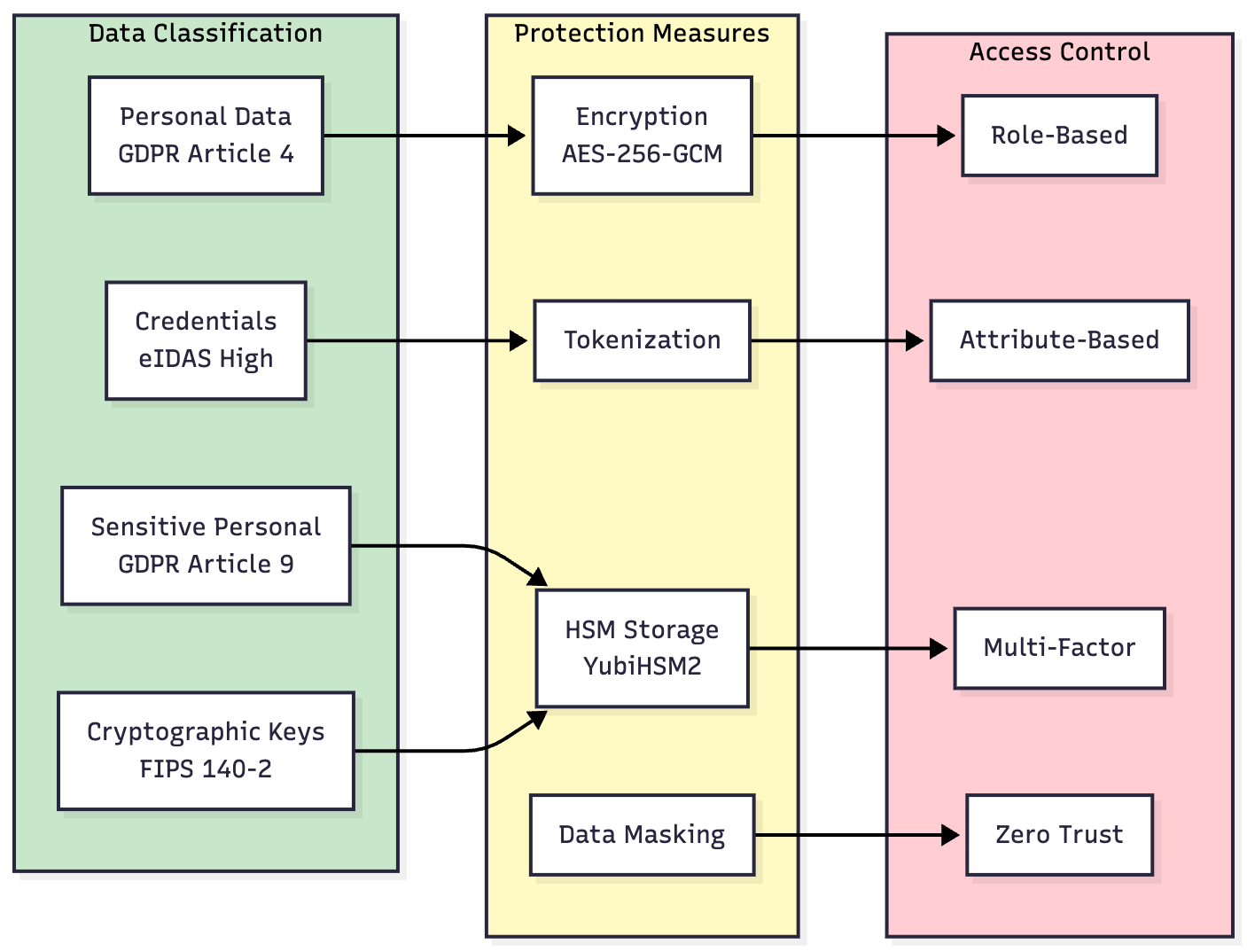
Privacy-enhancing technologies embedded throughout the platform. Data minimization through selective disclosure mechanisms. Purpose limitation enforced through policy controls. Storage limitation with automated retention and deletion workflows. Encryption protects personal data at rest and in transit.
Integrated support for data subject rights requests. Right of access: efficient retrieval of personal data and processing records. Right to rectification: workflows for updating inaccurate data. Right to erasure: automated deletion with verification. Right to data portability: export personal data in structured formats.
Maintain comprehensive records of processing activities as required by GDPR Article 30. Document purposes of processing, categories of data subjects and personal data, recipients, international transfers, retention periods, and security measures. Generate reports for data protection authorities.
Framework for conducting and documenting Data Protection Impact Assessments (DPIAs). Template-based assessment workflows guide systematic evaluation of privacy risks. Document risk mitigation measures and residual risks. Maintain DPIA records for regulatory compliance and internal governance.
Data protection mechanisms including encryption, access controls, audit logging, and privacy-preserving processing designed to support GDPR compliance
Designed to support the European Digital Identity ecosystem and eIDAS2 regulatory framework
Orchestrate operations for qualified and non-qualified trust service providers. Manage electronic signatures, seals, timestamps, and registered electronic delivery services. Support compliance with technical standards and policy requirements. Coordinate with supervisory bodies and conformity assessment bodies.
Designed to support national EUDI Wallet implementations aligned with Architecture Reference Framework (ARF). Orchestrate Person Identification Data (PID) issuance, qualified and non-qualified electronic attestations of attributes (QEAA/EAA), and wallet attestation. Support cross-border recognition scenarios.
Coordinate qualified electronic signature creation and validation. Integration with remote qualified signature creation devices. Support for qualified certificates and advanced electronic signatures. Signature policy management and validation workflows designed to support eIDAS requirements.
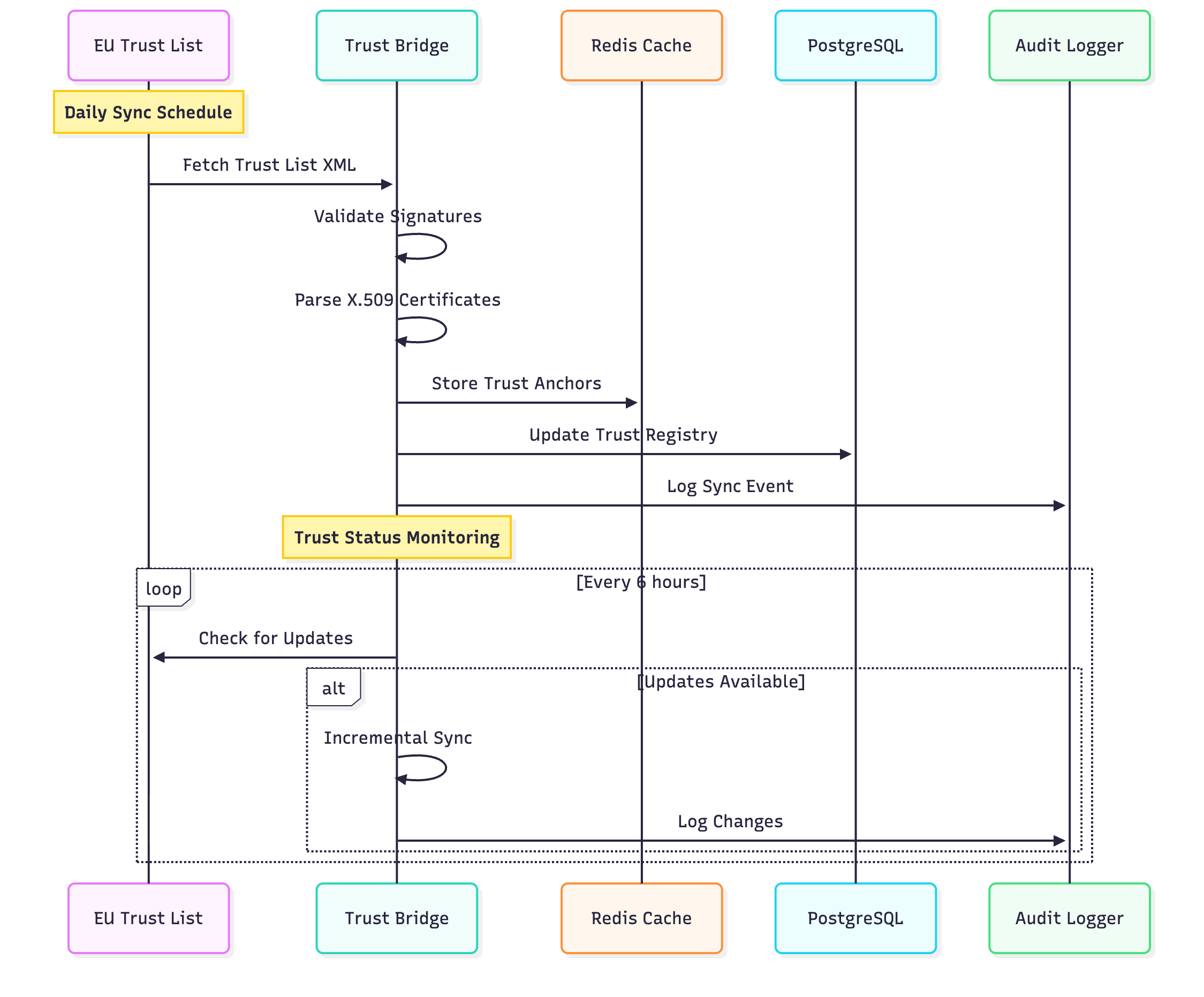
Manage trust frameworks defining governance rules, liability regimes, and technical requirements. Document trust scheme operators, trust service providers, and relying parties. Maintain trust lists and support mutual recognition arrangements between member states.
European Union Trusted Lists (EUTL) integration sequence showing how proConsul maintains synchronization with authoritative trust service status information
Support for industry-specific regulatory requirements
Designed to support KYC/AML requirements (4AMLD, 5AMLD, 6AMLD). Strong Customer Authentication compliance (PSD2). MiFID II investor identification. FATF guidance on digital identity. Transaction monitoring and suspicious activity reporting integration.
Healthcare professional credentialing. Patient identity management supporting clinical safety. Medical device operator authentication. Designed to consider healthcare data protection requirements and professional secrecy obligations.
SIM registration and subscriber identification (GSMA requirements). Network access authentication. Lawful intercept and data retention compliance. Support for telecommunications regulatory frameworks across jurisdictions.
Critical infrastructure protection and operator credentialing. Smart grid authentication and IoT device management. Compliance with NERC CIP and sector-specific cybersecurity frameworks. Supply chain security and vendor identity verification.
Comprehensive logging and reporting capabilities for compliance and operational oversight
All platform operations generate audit events including authentication attempts, policy evaluations, credential operations, approval decisions, configuration changes, and data access. Events include contextual information: user identity, timestamp, source IP, operation performed, outcome, and business context. Structured logging enables efficient search and analysis.
Powerful search capabilities across audit logs. Filter by time range, user, operation type, outcome, and custom attributes. Aggregate statistics for operational intelligence and compliance reporting. Export search results for external analysis or regulatory submission. API access for programmatic audit log retrieval.
Pre-built dashboards for common compliance scenarios. Track data subject rights request processing times. Monitor policy violations and exception rates. Visualize approval chain completion metrics. Alert on anomalous patterns requiring investigation. Export dashboard data for board-level reporting.
Scheduled generation of compliance reports. Regulatory submission formats for data protection authorities and trust service supervisory bodies. Internal governance reports for audit committees and management. Customizable report templates. Automated delivery via email or secure file transfer.
Organizational governance capabilities for policy management and oversight
Formal policy development, review, approval, and publication workflows. Version control maintains policy history. Impact analysis before policy changes. Stakeholder review and consultation processes. Policy retirement and archival procedures.
Enforce segregation of duties through role-based access control. Prevent conflicts of interest through policy controls. Multi-person approval requirements for sensitive operations. Maker-checker workflows for configuration changes. Oversight roles with view-only access for monitoring.
Risk register maintenance for identified risks to digital identity operations. Risk assessment workflows with standardized criteria. Mitigation planning and tracking. Residual risk acceptance authority and documentation. Regular risk review and reporting to governance bodies.
Formal change control for platform configuration and policy modifications. Change request workflow with impact analysis, testing, and approval gates. Rollback capabilities for failed changes. Change history and audit trail. Emergency change procedures with enhanced oversight.
proConsul is designed to support compliance with relevant standards and regulatory frameworks
Note: References to standards and regulations indicate design alignment and intended support. Organizations deploying proConsul remain responsible for their own compliance programs and should conduct appropriate assessments with qualified legal and compliance advisors.
Our compliance and governance specialists can help you understand how proConsul supports your regulatory obligations.