
proConsul is composed of specialized modules that work together to deliver comprehensive orchestration, governance, and management of digital trust services at enterprise and government scale.
Each module addresses specific aspects of digital trust orchestration, working together as an integrated platform
Central governance framework for identity and credential management. Define organizational policies, manage identity providers, configure attribute authorities, and establish trust frameworks. Support for hierarchical organizational structures with delegation and oversight controls.
Complete lifecycle management for digital credentials from issuance through expiry or revocation. Manage credential schemas, attribute definitions, and validity rules. Support for multiple credential formats including W3C Verifiable Credentials, ISO/IEC 18013-5 mDL, and X.509 certificates.
Sophisticated workflow engine for credential operations. Configure multi-step approval chains, conditional routing, and automated decision-making. Support for parallel approvals, escalation procedures, and exception handling with comprehensive audit trails.
Fine-grained access control and attribute management. Define attribute-based access control policies, manage attribute authorities, configure attribute schemas, and govern attribute release policies for privacy-preserving identity federation.
Enterprise-level threat intelligence aggregation and routing. Integrate fraud signals from idGuard AI, external threat feeds, and security monitoring systems. Route threat intelligence to appropriate response teams and coordinate protective measures across the ecosystem.
Comprehensive compliance monitoring and reporting. Generate regulatory reports, manage audit evidence, track data subject rights requests, and maintain compliance documentation. Designed to support GDPR, eIDAS2, and sectoral regulatory requirements.
Multi-tenant architecture supporting organizational separation and environment segregation. Manage development, testing, staging, and production environments with appropriate isolation and promotion workflows. Support for both single-tenant and multi-tenant deployment models.
Unified API gateway for all platform integrations. Manage API authentication, rate limiting, and traffic routing. Support for REST, GraphQL, and event-driven architectures. Comprehensive API lifecycle management including versioning, deprecation, and developer portal.
proConsul modules are designed to operate as an integrated system, sharing data and coordinating actions across the platform
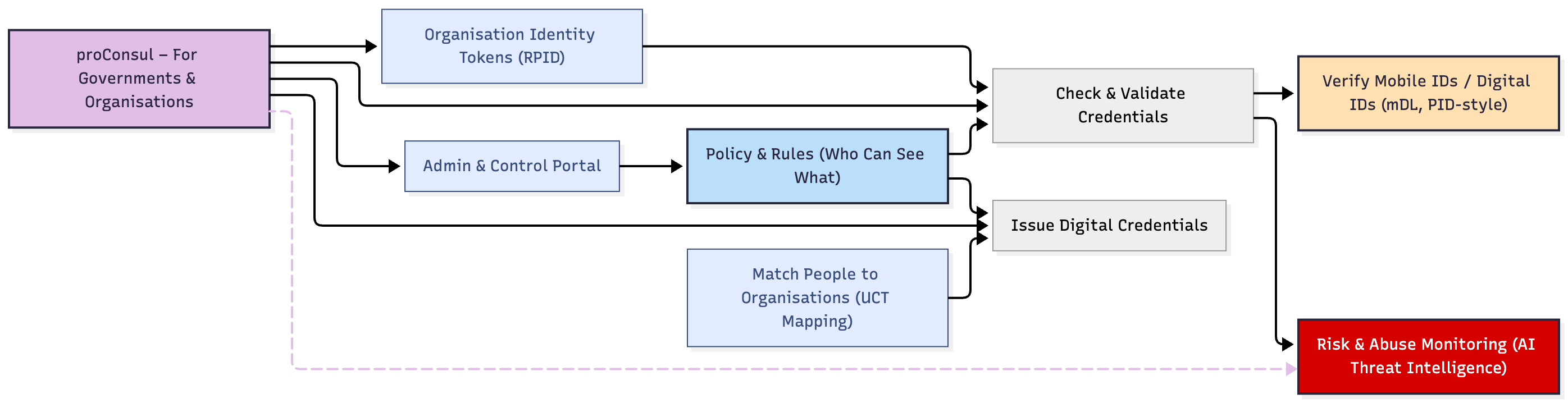
proConsul's modular architecture enables coordinated orchestration of identity, credentials, and trust services across the entire digital trust ecosystem
When a credential issuance request arrives, multiple modules coordinate seamlessly: The API Gateway authenticates and routes the request. Identity & Credential Governance validates policies. Issuance Workflows orchestrates approvals. Access Policy Management determines attribute release. Fraud Signals performs risk assessment. Compliance Reporting logs evidence. Credential Lifecycle manages the credential state and coordinates with TrustVault for cryptographic operations.
When a threat is detected in the idGuard consumer wallet ecosystem, the Fraud Signals & Threat Intelligence module processes and correlates the signal. Based on risk scoring, it may trigger automated protective actions through Issuance & Revocation Workflows (suspending at-risk credentials), notify security teams through integrated monitoring systems, and ensure all actions are properly documented by the Compliance Reporting module.
proConsul modules can be extended and customized to meet specific organizational requirements
Develop custom workflow templates tailored to your organizational processes. Use the workflow engine's visual designer or define workflows programmatically through APIs.
Build custom integrations with proprietary systems or specialized services. Use standard integration patterns or develop custom connectors using the proConsul SDK.
Develop organization-specific modules that leverage the proConsul platform infrastructure. Custom modules integrate seamlessly with core modules and follow the same security and compliance patterns.
Extend the platform's REST APIs with custom endpoints for specialized operations. Implement custom business logic while maintaining consistent authentication, authorization, and audit patterns.
See how these modules work together in real-world use cases across government and enterprise scenarios.